
Last Updated: November 4, 2026
Quick Summary
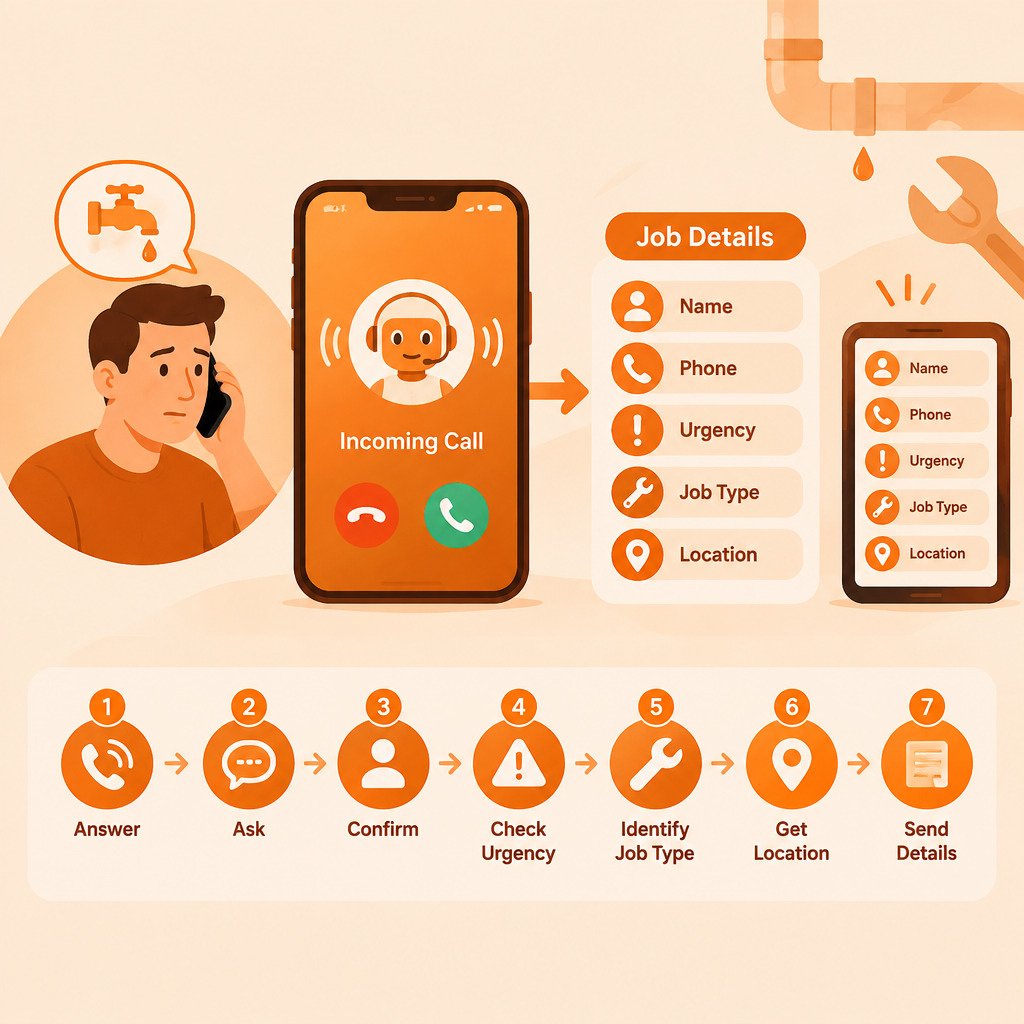
To collect job details from plumbing callers, get the caller's name and callback number first, then the full service address, problem type, and urgency. Ask whether water is running now, and read the details back before ending the call. Use a fixed intake order so nothing gets missed when you can't pick up.
- Get the callback number early so you keep the lead even if the call drops.
- Ask whether water is actively running to separate emergencies from routine repairs.
- Read the address and problem back to the caller to catch errors before a trip.
- Use one consistent dispatch summary so the plumber has everything before rolling.
Table of Contents
- Why Missed Plumbing Calls Cost You Jobs
- Step 1: Prepare a Plumbing Intake Form Template
- Step 2: Follow a Plumbing Phone Script for New Customers
- Step 3: Ask Diagnostic Questions by Problem Type
- Step 4: Triage Emergencies and Burst Pipes
- How to Qualify Plumbing Leads Before You Call Back
- Where an AI Answering Service for Plumbers Fits In
- Set Up Your Next Intake Call Today
- Frequently Asked Questions
If you run a plumbing business, every missed call from a plumbing caller is a potential job that can go to another company. When you're under a sink or on a roof, the phone rings and goes to voicemail. Many callers don't leave a message, and some call the next company they find. Learning how to collect job details from plumbing callers, even when you can't pick up, can keep that revenue in your business.
This guide walks through seven practical steps. You'll get a simple intake form, a phone script you can use, diagnostic questions by problem type, a way to triage emergencies, and a checklist for qualifying leads. At the end, we'll look at where an AI answering service fits in if you can't answer every call yourself.
Why Missed Plumbing Calls Cost You Jobs
A missed call is more than a missed conversation. It's a homeowner with a leak, a clog, or a water heater that just quit, and they need help now.
Callers often move on to the next result they find. To see how a missed-call capture service handles HVAC and similar trade calls, check out how missed-call capture works for trades.
Here's what that looks like in a normal week:
- A burst pipe call comes in while you're soldering a joint in a crawl space.
- A homeowner calls about a slow drain while you're on another job.
- An after-hours caller gets voicemail and calls a different company in the morning.
None of these callers is a bad lead. They just reached someone who didn't answer.
The fix isn't answering faster on every call. It's making sure that when you can't pick up, you still capture the details you need to call back and quote the job.
Step 1: Prepare a Plumbing Intake Form Template
Before you can collect job details from a caller, you need to know which details matter. A simple template keeps you and anyone else who answers the phone on the same page.
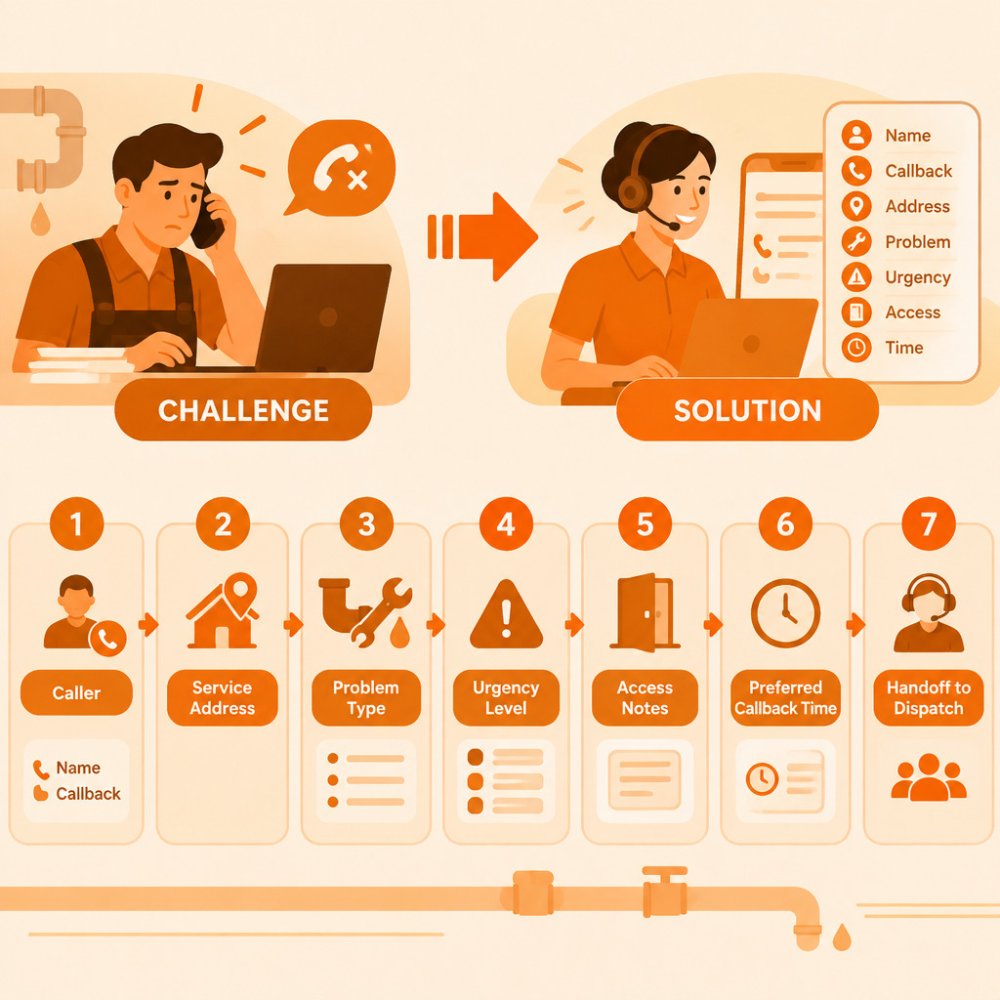
Your intake form should capture these fields, in this order:
- Caller name and callback number. Confirm the number they're calling from, and ask if it's the best number to reach them.
- Service address. Get the full street address, plus any apartment or unit number.
- Problem type. Leak, clog, water heater, fixture, sewer, or something else.
- Urgency level. Is water actively running, or is this a routine repair?
- Access notes. Gate codes, pets, parking, or whether someone will be home.
- Preferred callback time. When can the caller take a call back?
- Handoff to dispatch or you. Who gets the lead, and how?
Keep a printed copy by the phone and a digital version in your notes app. The goal is consistency. Every caller gets the same five or six questions, so you never have to guess what you missed.
Tip: If you use a shared job-tracking system, make the template match its fields. Copying data from a notepad into a second system is where details get lost.
Step 2: Follow a Plumbing Phone Script for New Customers
A script doesn't make you sound robotic.
A good intake call follows a clear order, so here is one you can adapt.
1. Open with identification and a brief apology.
"Thanks for calling [Business Name], this is [Your Name]. Sorry we missed you. Can I grab your name and the best number to reach you?"
Get the callback number early. If the call drops, you still have a lead.
2. Confirm consent to be contacted.
"Is it okay if we text or call this number to confirm details?"
A quick yes protects you and sets expectations. Keep the answer in your notes.
3. Screen the service address against your area.
"What's the address where you need service?"
If the address is outside your service area, say so politely and offer a referral if you have one.
4. Ask what's happening in plain language.
"Can you tell me what's going on? Is water running right now, or is this something you can schedule?"
This one question sorts emergencies from routine work without sounding like an interrogation.
5. Capture access and timing details.
"Do we need to know anything about getting in, like a gate code or a pet?
6. Read the details back.
"Just to confirm, I have you at [address] with a [problem type], and we'll call you back at [time]. Does that sound right?"
Repeating the details catches errors before they cost you a trip. A wrong street number means a wasted drive.
7. Close with a clear next step.
"Thanks, [Name]. We'll call you back at [time] to confirm. If anything changes before then, call us back at this number."
Watch out: Don't read the script word for word like a form. Callers hear that instantly.
A note on privacy and consent. You are collecting names, addresses, and contact details, which are personal information.
| Script step | What you collect | Why it matters |
|---|---|---|
| 1. Identify and apologise | Name and best callback number | You keep the lead even if the call drops |
| 2. Confirm consent | Permission to call or text | Protects you and sets expectations |
| 3. Screen the address | Full service address | Catches jobs outside your service area |
| 4. Ask what's happening | Whether water is running now | Separates emergencies from routine work |
| 5. Capture access and timing | Gate codes, pets, callback time | Avoids a second trip or missed call |
| 6. Read details back | Confirmed address, problem and time | Catches errors before they cost a trip |
| 7. Close with next step | Confirmed callback time | Gives the caller a clear expectation |
Step 3: Ask Diagnostic Questions by Problem Type
Some calls are easy to categorize. "My toilet won't stop running" is a fixture issue. Others need a few more questions to understand the job before you show up.
Use these as starting points. Ask only what fits the call.
Clogs and slow drains
- Which fixture is slow: kitchen, bathroom, shower, or main line?
- Is more than one drain affected?
- Has it happened before, and did a previous fix work?
Leaks
- Where is the water coming from: ceiling, wall, floor, under a fixture?
- Is the leak still active, and is it getting worse?
- Can they shut off the water supply to that area?
Water heaters
- Is there no hot water at all, or is it lukewarm?
- Is there water pooling around the base?
- How old is the unit, if the caller knows?
Sewer backups
- Is sewage coming up in tubs, toilets, or floor drains?
- Has anyone in the home already tried a drain snake or chemical cleaner?
Write the answers in the access or notes field of your intake form. When you call back, you'll know what tools and parts to bring.
Step 4: Triage Emergencies and Burst Pipes
Not every call is equally urgent, and some need immediate action. A simple triage rule helps you decide what to do first, what to tell the caller, and what to hand off to dispatch.
Sort the call into one of three buckets.
- Emergency: Water is actively flowing or spraying, sewage is backing up into the home, water is near electrical panels or outlets, or there is a gas smell near a water heater or gas line. Get the address and callback number first, then schedule the visit as soon as you can.
- Same-day: A leak that is contained but active, no hot water in a home with young children or elderly residents, or a single fixture that has stopped working. Offer the next available window.
- Routine: A dripping faucet, a slow tub drain, or a quote request for a future install. Put it in the callback queue.
Safe steps you can suggest. For an active water leak, you can ask the caller to shut off the main water supply if they know where it is and can reach it safely. You can ask them to move valuables away from the water and to put towels down. For a gas smell, tell them to leave the building and call the gas utility or 911 from outside. These are common-sense steps, not diagnosis.
What not to say. Don't walk a caller through opening a water heater, resetting a breaker, or working on a gas line. Don't guess at the cause of a leak or a backup over the phone. If you want to see how a capture service grabs the address and urgency when the shop cannot pick up, read how after-hours burst-pipe and clog calls are captured.
Hand off with a dispatch-ready message. When you pass an emergency to a plumber or dispatcher, send a short summary in a consistent format so nothing gets lost:
Job: [problem type] Address: [full address] Caller: [name] / [callback number] Urgency: Emergency / Same-day / Routine Status: Water shut off? Yes / No / Unknown Access: [gate code, pets, someone home] Notes: [what the caller described]
A template like this takes thirty seconds to fill in and gives the plumber everything they need before they roll. It also gives you a record if the caller disputes what was promised.
Watch out: Don't promise a specific arrival time on an emergency call unless dispatch has confirmed it. A missed promise on a burst pipe turns a lead into a complaint.
How to Qualify Plumbing Leads Before You Call Back
Once you have the intake details, a quick qualification check tells you whether the lead is worth an immediate callback, a scheduled visit, or a quote.
Score each lead on these points:
- Urgency: Emergency, same-day, or routine?
- Location: Is the address inside your service area?
- Job type: Is it work you do, or something you'd refer out?
- Contact quality: Did you get a working callback number and a clear address?
- Budget signals: Did the caller mention a previous quote, a property manager, or an insurance claim?
Leads that score high on urgency, location, and contact quality should get a callback first. Routine leads can go into a queue for later in the day.
Keep a short note for each lead, even if the job doesn't close. Over time, these notes show you which problem types bring in the most calls and which neighborhoods bring in the best work.
Where an AI Answering Service for Plumbers Fits In
If you're on jobs all day, you can't answer every call. An AI answering service can handle the calls you miss and collect the intake details described above.
Here's how CallGrabbr works for plumbing businesses:
- You keep your existing business number.
- Unanswered calls forward to CallGrabbr.
- The system asks for the caller's name, address, problem type, and urgency.
- You receive a lead summary by text or email, so you can call back with the details in hand.
It's important to know what this does and doesn't do. CallGrabbr captures the lead. It doesn't book the appointment or complete the sale. You still make the callback, confirm the job, and do the work.
If you're weighing this against hiring a part-time receptionist or relying on voicemail, compare the cost of a missed job against the monthly cost of the service. Current plan pricing, trial terms, and included features are listed on the CallGrabbr pricing page. Check there for current prices or a quote before you decide.
For plumbers who want to learn more about how the service works, visit the CallGrabbr website.
Set Up Your Next Intake Call Today
Start small this week. Print the intake form, write your opening line on a sticky note, and keep both by the phone. Use the triage rules for your first emergency call, and track how many leads you capture from missed calls over the next two weeks.
If you want to see how automated intake works before changing anything, you can start the 14-day trial at callgrabbr.com. Check the current trial terms on the site before you sign up.
Frequently Asked Questions
What information should I ask for when a plumbing customer calls?
At minimum, collect the caller's name, a callback number that works, the full service address, and a plain-language description of the problem. Add access notes such as gate codes or pets, whether water is actively leaking, and the caller's preferred callback window. Keep the order consistent so nothing gets skipped when you are busy. Once you have these details, you can decide whether to book, call back, or escalate the job, and you can do it without rehashing the call.
How do I qualify plumbing leads over the phone?
Ask whether the problem is an emergency, such as active flooding, a burst pipe, or sewage backing up, and whether anyone is at risk. Then ask about the job type, the age of the fixture or system if relevant, and whether the caller needs service today or can wait. Note the service area so you can confirm it is within your territory. A lead that is in your area, has a clear problem, and has a specific timeline is usually worth a prompt callback. Use your own pricing and availability rules to decide the rest.
Should I use an AI answering service for my plumbing business?
It depends on how many calls you miss while working and how consistent your intake needs to be. An AI answering service can answer calls you cannot reach, collect caller name, address, job type, and urgency, and send a lead summary to your phone by text or email. It does not guarantee a booking, and calls that need judgment still need your follow-up. CallGrabbr is one option; check its current pricing and trial terms on its website before deciding.
How can I capture plumbing lead details while on a job site?
Keep your intake form in your phone's notes app or a simple text template so you can fill it in quickly between tasks. Let unanswered calls go to voicemail or an answering service instead of stopping mid-repair. When you return the call, start from the lead summary rather than asking the caller to repeat everything. This cuts down on callbacks and keeps the customer from feeling passed around.
